

The Hotel Warwick: Newport News’s Grand Dame, Civic Hub, and Survivor |
The Hotel Warwick: Newport News’s Grand Dame, Civic Hub, and Survivor |
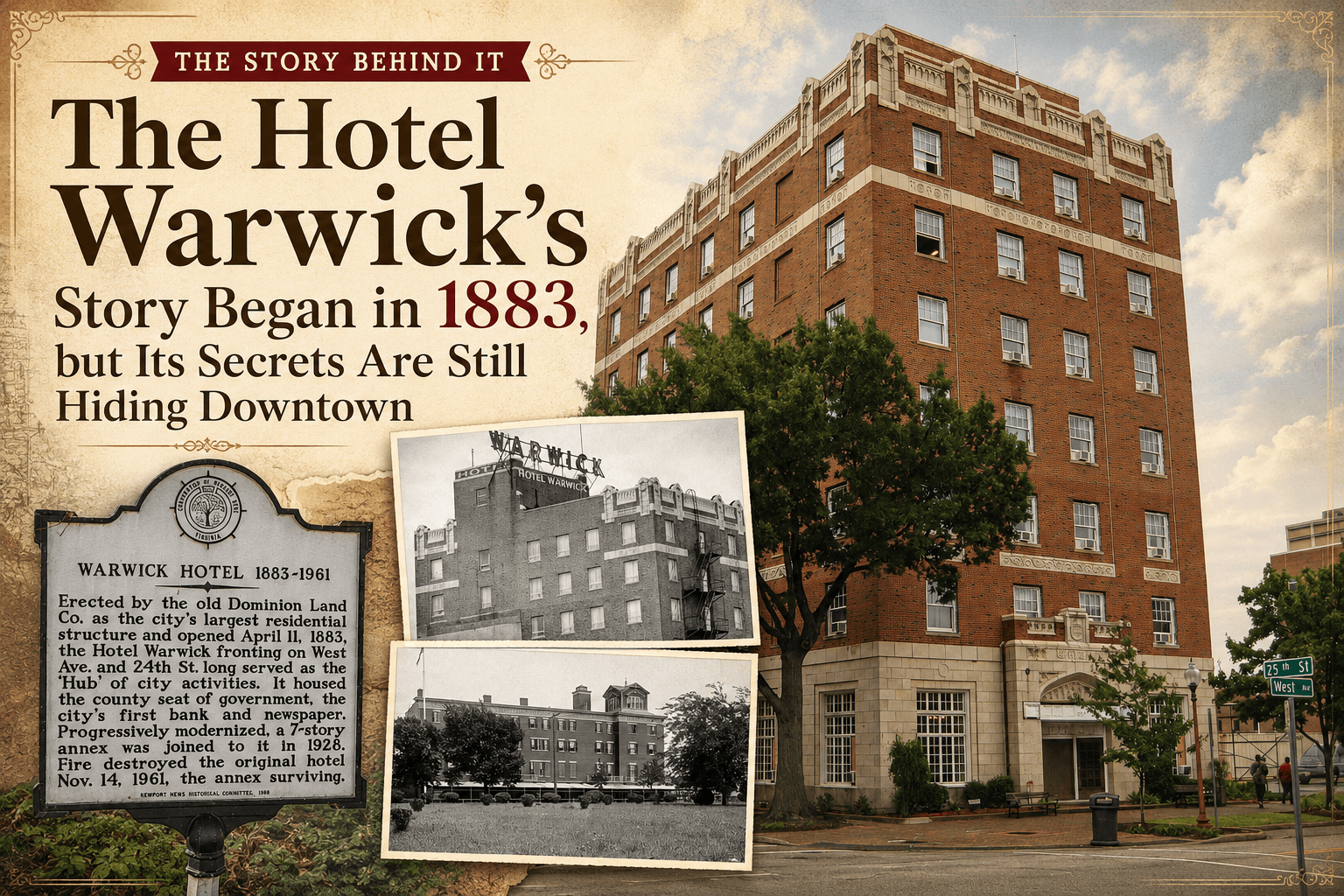
Picture downtown Newport News in the spring of 1883. The new Chesapeake and Ohio Railway terminus was surrounded by more mud than city. Most of the area’s roughly 1,000 residents lived near the rough waterfront known as Hell’s Half Acre. West of 25th Street, there were only nine buildings, and two of them were saloons. Then came the Hotel Warwick. The four-story Victorian hotel opened on April 11, 1883. Built by Collis Huntington’s Old Dominion Land Company, it featured decorative towers, a grand staircase, and ambitions much bigger than the town around it. Huntington hoped the Warwick would become a winter resort for Northern tourists. Instead, it became something even more important. It became the center of life in a growing city. The Hotel at the Heart of TownJohn R. Swinerton, the hotel manager hired by Huntington, arrived in Newport News three months before the Warwick opened. After missing the daily train from Phoebus, Swinerton joined two strangers and paid a carriage driver $1.50 for each passenger. The trip took about three hours over muddy and ice-covered roads. When he arrived, the Warwick was still unfinished, and Newport News looked more like a construction site than a town. Swinerton first managed the temporary Lafayette House Inn, which housed traveling salesmen while the Warwick was being completed. That building later became the city’s first hospital. When the Hotel Warwick finally opened, Swinerton held a formal banquet for prominent guests from across the Peninsula. The Chesapeake and Ohio Railway ran a special train from Old Point and Hampton directly to the hotel. The Warwick quickly became much more than a place to spend the night. Its ground floor held the only drugstore and the only barbershop in town. The hotel also temporarily housed the Warwick County courthouse, customs house, post office, and the city’s first bank. Across West Avenue stood Casino Park, a landscaped gathering place with an entertainment hall, bathing beach, pier, and bathhouses. Residents gathered there for lectures, dances, public events, and even a revival led by evangelist Billy Sunday. A room at the Warwick cost $4 per day or between $21 and $25 per week. John Chamberlin of the famous Chamberlin Hotel at Old Point called it “the best hotel south of Washington.” The Warwick proudly adopted the phrase as its motto. Famous Guests and Lobby StoriesThe hotel welcomed military leaders, entertainers, railroad executives, and travelers from across the country. Admiral George Dewey stayed there, along with Generals Phil Sheridan and Winfield Scott Hancock. Entertainers performing at the nearby Academy of Music included Al Jolson and W. C. Fields. Collis Huntington often arrived from New York aboard his private railroad cars. Shipyard president Calvin Orcutt regularly met associates in the hotel’s palm-filled lobby, where business conversations sometimes continued into late-night games of pool. When there was little evening entertainment in town, Swinerton organized nightly games of whist in the lobby. The hotel was where residents met, shared news, discussed business, and helped shape the future of Newport News. Newport News Gets Its First SkyscraperAs the city grew, the Warwick changed with it. The hotel was renovated in 1901. By 1915, every guest room had hot and cold running water and a telephone. During World War I, the restaurant expanded, and a smaller addition was built along 25th Street. The biggest change came in 1928, when a seven-story tower with 72 rooms rose beside the original Victorian hotel. The expansion brought the Warwick’s total to about 202 rooms. Designed with Art Deco and Tudor Revival details, the tower became Newport News’s first skyscraper, first tower hotel, and first fireproof hotel. During World War II, the complex expanded to as many as 275 rooms. Military personnel and workers supporting the nearby shipyards stayed inside. At one point, the entire second floor served as military barracks, while the ballroom was divided into extra sleeping rooms. The dining room remained a favorite meeting place for shipyard executives, while the ballroom hosted civic dinners and community gatherings. The Fire That Changed EverythingOn November 14, 1961, fire tore through the original 1883 hotel. Firefighters could not save the old Victorian wing, but they protected the seven-story tower. The surviving building suffered smoke and water damage, but it remained standing. The Warwick continued operating for several more decades. Overnight hotel service finally ended in 1988. By then, downtown Newport News and the travel industry had changed dramatically. The building needed a new purpose. A Place of Second ChancesDuring the 1990s, the former hotel was renovated into housing for people experiencing homelessness and mental illness. A building that once served admirals, entertainers, railroad leaders, and shipyard executives became a place of stability for residents who needed a fresh start. The Hotel Warwick was listed on the National Register of Historic Places in 1984. The surviving tower remains at 2410 West Avenue, across from the Victory Arch and near the James River waterfront. The large neon sign that once crowned the hotel was removed during renovations in 1983. Today, a mural called The Listener covers one side of the building. Often nicknamed Mr. Warwick, the mural shows a sharply dressed man holding a pencil and notepad. It honors the hotel’s long history as a place where people gathered, listened, and shared the stories of Newport News. From muddy railroad outpost to civic center, celebrity stopover, wartime housing, and a place of second chances, the Hotel Warwick never stopped serving downtown. Its purpose changed, but its place in the city’s story never disappeared. |
23 Comments
Join the conversation
Kinda wish they could’ve saved the old wing in the fire. Would’ve been amazing to have that Victorian part still around. But at least the tower survived.
Brings back memories of walking by the hotel after concerts at the Academy of Music. Never went inside but the place always looked busy.
It’s great to hear the Warwick was such a vibrant part of your memories, its lobby was indeed bustling, especially when events were happening at the Academy of Music nearby.
Always wondered what that building across from the Victory Arch used to be. Now I finally know! Thanks for filling in some gaps for me.
We’re so glad to help connect those dots! The Warwick has quietly watched over downtown and holds generations of Newport News stories within its walls.
Collis Huntington must have really believed in downtown to build something so fancy in all that mud. Bold move if you ask me.
I wish more old hotels got repurposed instead of being torn down. The Warwick is such a good example of giving a building new life.
We agree, preserving and repurposing spaces like the Warwick not only honors their legacy but also gives them a whole new role in the community.
Wild how many ‘firsts’ that hotel had. First skyscraper, first fireproof place, first to get phones in rooms. Cool to see how much history is packed into one spot.
Absolutely, so many 'firsts' for Newport News came from the Warwick, making it a cornerstone of architectural and civic history in the city.
Do any photos of the original Victorian building exist? I’d love to see what it looked like before the fire.
Yes, a few historic photos of the original Victorian building do exist in local archives, capturing its decorative towers and unique 19th-century charm before the 1961 fire.
Honestly kind of moving to know the hotel ended up being a safe place for people going through hard times. Says a lot about Newport News.
I always thought the Listener mural looked a little out of place, but reading this made me appreciate what it stands for. It fits way more than I realized.
Hell’s Half Acre as a neighborhood name is the most old school thing I’ve ever heard. I wonder how wild those two saloons got.
Tommy J.I’ve seen old pictures of Hell’s Half Acre and it looked pretty rough! I bet those saloons had some wild nights, especially with all the railroad workers passing through.
I miss the neon sign. Used to drive by it as a kid and think it looked like something out of an old movie. Glad the mural is there now but I wish the sign had stayed.
Thank you for sharing your memory, the neon sign was truly iconic! While its removal marked the end of an era, it's wonderful that the mural preserves the building's spirit today.
$4 a night doesn’t sound like much, but I bet that was a lot in 1883! Still, seems like you got a lot for your money back then.
You're right, $4 a night in 1883 was quite substantial, but guests enjoyed grand amenities and services that made the Warwick 'the best hotel south of Washington' at the time.
My grandma stayed at the Warwick in the 70s once for a shipyard event. She always talked about the view of the James River from the dining room!
The fact that military folks and shipyard workers lived in the Warwick during WWII is wild. Can’t imagine what the lobby must have sounded like during those days.
It must have been quite a scene, during WWII, the Warwick was filled with the energy of military personnel and workers, turning its halls and lobby into a true wartime crossroads.